But does a formula need to include more ingredients to be complete? Not necessarily. An effective combination depends first and foremost on the complementary nature of the active ingredients, their dosage, their form, and their compatibility with the chosen formulation.
1. Micronutrients: An Essential Foundation
Certain vitamins and minerals have authorized health claims related to the normal functioning of the immune system. They therefore provide a valuable foundation for building a formula.
Vitamin C
Vitamin C contributes to the normal functioning of the immune system. It is also known for its natural presence in many fruits and vegetables.
In a formula, it can be used alone or combined with other micronutrients to create a more comprehensive approach.
The choice of vitamin C form can also be critical depending on the desired dosage and dosage form: ascorbic acid, ascorbates, or other forms available from ingredient suppliers.
Vitamin D
Vitamin D supports the normal functioning of the immune system. It is therefore a particularly valuable active ingredient in formulations intended for periods when sun exposure is more limited.
It can be combined with vitamin C and zinc to create a balanced blend of micronutrients.
Zinc
Zinc contributes to the normal functioning of the immune system and also plays a role in numerous physiological functions.
Combining it with vitamins C and D creates a formula based on several micronutrients that fall within an established framework of health claims.
Key takeaway: Vitamin C + vitamin D + zinc constitute a simple and clear combination for an immunity-focused formula, provided that the conditions for using the claims and the applicable regulatory dosages are followed.
2. Herbs: Adding a Botanical Dimension to the Formula
Beyond vitamins and minerals, plant extracts allow for the development of a distinct formula identity.
Elderberry, for example, is commonly used in products marketed for the winter months. Other plants may also be considered depending on the concept being developed, the ingredient’s regulatory status, and the target market.
The value of plants lies particularly in the ability to create a predominantly botanical formula or to supplement a micronutrient base.
However, their inclusion requires special caution: the use of a plant extract does not automatically mean that a health claim can be associated with the product. It is important to verify the regulatory framework applicable to each ingredient and each market.
3. Natural Ingredients: Building a Unique Position
For some brands, the goal is not only to offer an “immunity” formula, but also to develop a brand identity centered on natural ingredients, botanicals, or nutrition.
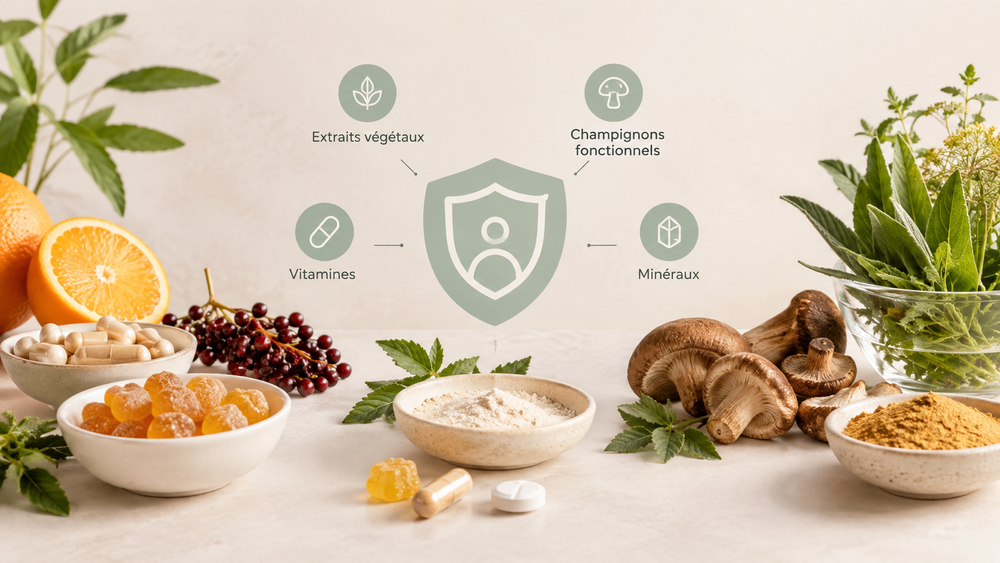
In this context, various categories of ingredients can be considered:
- plant extracts;
- mushrooms;
- vitamins and minerals;
- ingredients derived from fruits or plants;
- standardized active ingredients backed by appropriate technical and scientific documentation.
Functional mushrooms, such as reishi, shiitake, or maitake, can, for example, be incorporated into formula concepts inspired by mycotherapy. In particular, they allow for the development of a distinct product identity, provided that marketing communications comply with the applicable regulatory framework.
4. Should multiple families of active ingredients be combined?
Combining multiple families can be beneficial when it serves a genuine formulation purpose.
Example 1: Essential formula
Vitamin C + vitamin D + zinc
A concise, easily understandable combination suited to a formula focused on micronutrients.
Example 2: Botanical formula
Vitamin C + zinc + plant extracts
This approach allows for maintaining a micronutrient base while giving greater prominence to botanical ingredients.
Example 3: Premium Formula
Vitamins + minerals + a selection of plant extracts + a unique active ingredient
This approach allows for the development of a more comprehensive concept and further enhances the product’s differentiation.
Example 4: Mushroom-Based Formula
Selection of mushrooms + micronutrients
This approach capitalizes on the trend toward functional mushrooms while maintaining an easily identifiable nutritional foundation.
The goal, therefore, is not to simply pile on ingredients, but to create a combination that aligns with the product’s positioning, daily dose, dosage form, and messaging.
5. The choice of active ingredients must also take the dosage form into account
A formula that looks sound on paper can become much more complex to produce when it must be incorporated into a specific dosage form.
For gummies, for example, several factors must be considered:
the amount of active ingredients to be delivered per dose;
- the taste and smell of the ingredients;
- stability within the matrix;
- compatibility with the manufacturing process;
- the number of gummies needed to achieve the desired dosage;
- the final size and weight of the product.
Some vitamins and minerals are relatively easy to incorporate into a gummy matrix, while other ingredients may present greater organoleptic or technological challenges.
The selection of active ingredients must therefore be carried out in parallel with the selection of the dosage form.
6. An immunity formula is more than just a list of ingredients
To develop an effective formula, several questions must be asked from the outset:
What is the product’s positioning?
Essential, natural, premium, botanical, family-friendly, seasonal…
What dosage form is desired?
Gummies, capsules, tablets, powder, sticks…
What daily dosage is feasible?
The dosage directly determines the number of ingredients that can be included and the product’s feasibility.
What is the target market?
Regulations and marketing opportunities may vary by country.
What messaging can actually be used on the product?
The formulation must be designed with authorized health claims and their conditions of use in mind.
Conclusion
Developing a formula designed to support immunity does not necessarily mean adding more active ingredients. A combination of vitamins and minerals possibly supplemented with plant extracts or other unique ingredients can enable the development of very different concepts depending on the desired positioning.
The key lies in the complementary nature of the ingredients, their dosages, their compatibility with the formulation, and, above all, in anticipating the regulatory constraints related to product marketing.
At Irati International, our catalog allows you to explore different combinations of active ingredients and various dosage forms to develop solutions tailored to trends in the dietary supplement market.
To learn more, check out our solutions designed for immune-boosting formulas and the various active ingredients available in our catalog.
The information presented in this article is provided for informational purposes only and is intended to highlight the characteristics and benefits of the various active ingredients. It does not constitute health claims intended for use on product labeling or in product communications. Any claims used on a product must comply with current regulations and applicable conditions of use.